


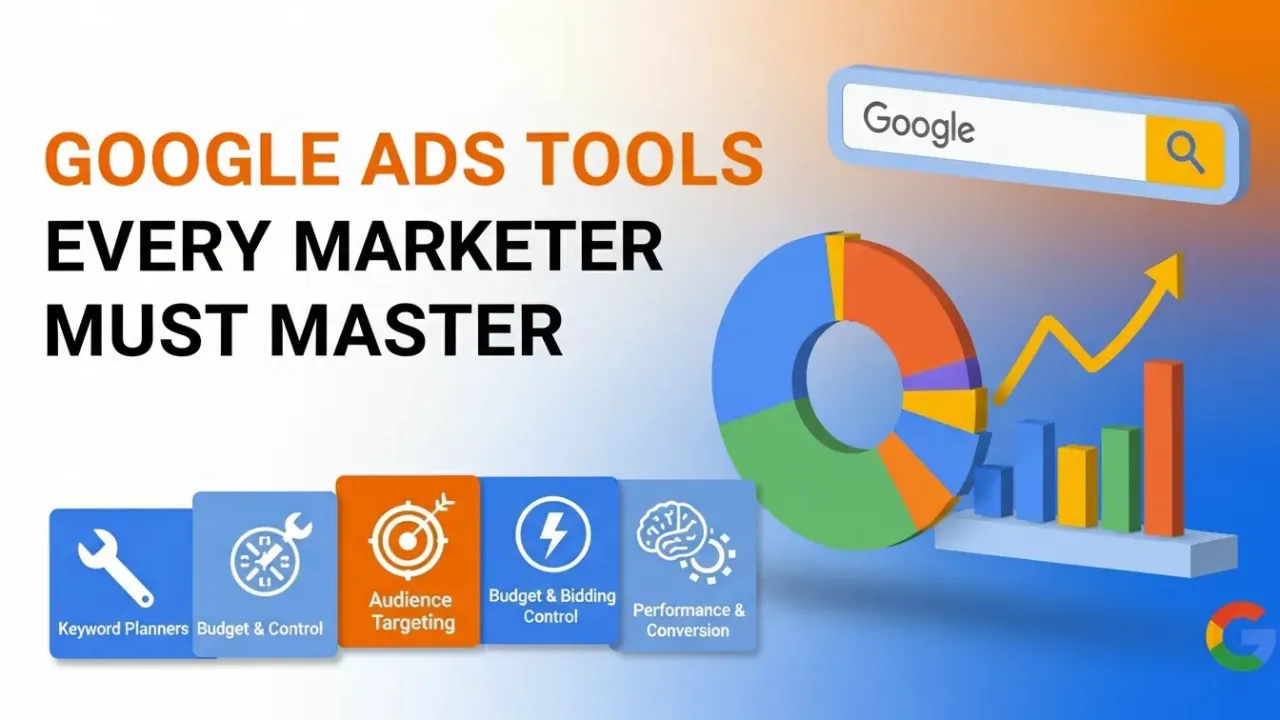
When most beginning marketers enter the Google Ads world, the first thing that most of them do is choose their keywords and write their ad copy. They fail to make use of all of the Google Ads features that allow them to manage, track, bid, and optimise their campaigns. All the features are important; however, your ability to understand how to use them properly can significantly increase the effectiveness of your Google Ads campaigns.
Understanding Google Ads’ many tools allows you to protect your marketing budget, find out which types of ads are effective versus those that are not, and successfully grow your campaigns. This guide takes you through the major Google Ads tools that every marketer needs to know in 2026, as well as why understanding how to use them correctly will help you when it comes to managing actual Google Ads budgets
Core Google Ads Keyword Planner Tools
As a marketer, you can use tools provided in Google Ads like Keyword Planner and Auction
Insights to help optimise, develop, and manage your advertising campaigns with complete
control over your budget. In addition to creating ads, these tools will help you protect your
budget, identify where your campaigns are performing poorly, and make better decisions at
all levels of your advertising campaigns.
1. Google Ads Keyword Planner
Using Keyword Planner, you can research and analyse what consumers are looking for, see
keyword suggestions, search volume, competition level, and how much to bid on average for
each keyword. The most critical point to remember about Keyword Planner is that the
keyword research indicates consumer intent to use that keyword and, therefore, may have a
direct impact on sales.
2. Google Ads Auction Insights
Auction Insights is an advertising analysis feature of Google Ads. It shows your competition
in relation to the other advertisers you are competing against in the same auctions. Auction
Insights can also report how many times your ads show up, where they show up in the
auction, and how many times your competitors have their ads displayed. By using Auction
Insights, you will see if your low-performance results are due to low bids, low relevancy, or
strong competition. Without Auction Insights, you are merely guessing your bid amount and
often submitting excessive bids.
3. Search Terms Report
Search Terms Reports showcase what a customer typed in order to see your advertisement.
Keywords allow you to show up in search results, but the search term will show you the way
that actual users are searching for things. It also identifies irrelevant search terms that are
using up your budget without you knowing about it. These irrelevant search terms can drain
your budget and thus need to be removed. This is one of the most essential tools within
Google Ads that an advertiser should frequently review for keeping budgets protected.
4. Quality Score Diagnostics
Quality Score Diagnostics shows how Google’s algorithm evaluates its key phrases in terms
of relatedness and the experience for users. It provides insight into the ad relevance,
expected CTR, and the landing page quality. If you have a low score, it will increase the
costs of your bids, even if your bids are high. There are very simple methods to increase
Quality Scores, such as more clearly constructed copy in the ad, having more organized
keyword groups, and improving the landing pages. An increase in Quality Score will result in
decreased costs and increased visibility, as well as overall performance.
Budget & Bidding Control Tools
Budget and bidding control tools, including Smart Bidding, Manual Bidding, Budget Reports,
Forecasting, and Campaign Experiments, help marketers manage spending and optimize
bids without overspending. These tools ensure campaigns run efficiently, prevent wasted
budgets, and give clear insights into performance trends. Next, we’ll explore each of these
tools and how they help marketers make smarter, data-driven decisions.
1. Smart Bidding vs Manual Bidding Tools
Google Ads offer various bidding options, helping to determine how much marketers spend
on clicks and conversions. The traditional manual bidding provides complete control over bid
management. While Smart Bidding utilizes a fully automated approach, utilizing algorithms to
manage bid adjustments based on available data. Automation is advantageous for accounts
that have enough data available; however, the lack of historical data can make using Smart
Bidding in new or low-data accounts difficult.
2. Budget Reports & Forecasting Tools
Marketers use budget reports and forecasting tools to track the expenditure of their
marketing funds and the rate of spending, and to monitor daily spending against monthly
budget limits so there aren’t any unexpected surprises at month-end. Forecasting also
provides an understanding of what results are expected, based on the current trends, which
aids marketers in making more informed budgetary decisions. In addition, budget reports
and forecasting tools can identify any leakage associated with ineffective campaigns that
have no results.
3. Campaign Experiments
Campaign experiments allow marketers to test different campaign variations without risking
the entire budget. With this type of testing, traffic is split, with half going to the original
version and the other half to the test version. For new marketers, testing new bid types, ad
copy, or landing pages without guessing is a safe way to experiment. The results from these
types of experiments provide data that enable marketers to have greater confidence in
making a decision when they test a new type of bid, ad copy, or landing page. Marketers can
gain knowledge through the data obtained in these experiments, rather than having to rely
solely on assumptions.
Performance & Conversion Tracking Tools
Performance and conversion tracking tools like Google Tag Manager, Conversion Tracking
Setup, and Google Analytics (GA4) integration let marketers see exactly how ads drive
results. They provide insights into user behavior, measure conversions accurately, and
prevent costly mistakes from wrong data.
1. Google Tag Manager
GTM is a tool that makes it easy to manage all tracking codes quickly, without having to edit
your website’s code. When managing your paid advertisement campaign, all decisions you
make regarding bidding, optimizing, and reporting will ultimately be dependent on the
accuracy of your tracking. With GTM, conversions can be set up and managed in one
location. New marketers often make errors such as doubling up on conversions or
overlooking critical actions. If marketers learn how to utilize GTM early in their careers, they
will help reduce or eliminate the risk of using inaccurate tracking data, which can negatively
impact their marketing results and lead to unnecessary expenditures on low-performing ads.
2. Conversion Tracking Setup
Conversion tracking is a system that defines what actions are important for your business,
such as a lead generation form, a phone call, or a purchase. When conversion tracking is set
up and used correctly, it tells Google which clicks have the most value. Inaccurate and/or
incomplete conversion tracking results in poor conversion rates for Smart Bidding and
optimization because Smart Bidding and optimization rely on accurate and complete
conversion tracking data. New marketers should focus on tracking actions of real value and
on properly testing conversion tracking. Accurate conversion tracking will ultimately lead to
greater performance and lower costs.
3. Google Analytics (GA4) Integration
Integrating Google Analytics 4 (GA4) with Google Ads provides a better understanding of
how users interact with your ads once they’re on your website. The primary focus of Google
Ads is on clicks and costs, whereas Google Analytics provides an overall view of user
behaviour, including how long they spent on your site, how many pages they viewed, and
when users left the website before converting. By adding Google Ads and Google Analytics
to your marketing toolkit, you will be able to find out which landing pages are getting lots of
clicks but very little in terms of conversions.
Ad Creation & Optimization Tools
1. Search Ads (RSA) Asset Reports
Responsive Search Ads allow Google to test different combinations of headlines and
descriptions automatically. The asset report shows which headlines and descriptions perform
best over time. This helps marketers understand what messages connect with users. By
improving or replacing low-performing assets, ads become stronger and more relevant.
Guessing ad copy rarely works, but data-driven updates lead to better results.
2. Ad Preview & Diagnosis Too
A powerful resource for marketers is the Ad Preview & Diagnosis Tool. It allows marketers to
view their ads without triggering real clicks or impressions and can also provide a thorough
explanation for why ads may not be running (Budget ceiling, Policy issue). Many beginner
advertisers search for their ad in Google to check how it looks; unfortunately, this generates
wasted impressions and can distort campaign performance data. The Ad Preview &
Diagnosis Tool helps to eliminate these errors and provides accurate information within
minutes. Using the Ad Preview & Diagnosis Tool saves money and time.
After evaluating a dozen of the leading Google Ads Tools for Marketers in 2026, it is easy to
see how these tools support advertisers in creating smarter and more efficient ad
campaigns. From Keyword Planner to Auction Insights to Quality Score Diagnostics, Bidding
Controls, and Tracking Tools, all of these tools are strategic components in planning,
optimizing, and scaling ad campaigns. These tools allow marketers to better protect their
budgets, improve performance, and turn data into actionable insights, while ad creation tools
allow for more precise messaging without wasting budget.
However, simply using tools will not lead to true mastery of Google Ads; it takes strategic
planning and consistent testing to maximize the value of each tool.
Google Ads Tools Are Powerful, But Only When Used Right
Knowing where and how to use the tools does not necessarily mean you can successfully
manage Google Ads. To master Google Ads, you need to know the purpose for which you
are using each tool and how to make the most of the data it provides you. Without proper
strategy, testing, and interpretation, even the best tools could lead to unwise decisions.
Most marketers begin their journey with Google Ads as beginners and are forced to use trial
and error while using a real budget to learn the platform. This can be a very expensive and
risky way to learn to use Google Ads, especially when the individual or business using
Google Ads is hoping to gain truthful, immediate results. If even one mistake is made with
either a setting or by a misreading of the report, the budget will be drained in a matter of
days.
By learning in a well-structured manner, marketers will be able to understand how to use the
different tools together, how to safely test changes, and how to interpret data regarding their
performance accurately. This will prevent them from making costly mistakes while helping
them become more confident in managing large or client-based Google Ads budgets.
How Proper Google Ads Training Prepares Marketers to
Drive Results
There is a big difference between learning Google Ads in theory and managing real money
for a business. When real budgets are involved, your every decision has an impact on
business growth. Mistakes don’t just affect performance; they affect trust, revenue, and
growth. That’s why proper training plays a critical role before a marketer is given control of
live campaigns.
Well-structured digital marketing training teaches marketers how to plan, track, and optimize
ads with purpose. The training goes beyond Google Ads alone. It covers the full picture,
including search engine optimization, social media ads, content strategy, analytics, and
conversion optimization. This all-around exposure helps marketers see how paid ads fit into
a larger marketing system. Instead of working in isolation, they learn how different channels
support each other. This builds confidence, accountability, and the ability to make safe
decisions under real pressure.
As we talk about digital marketing classes, you’ll mainly learn them in two tiers:
1. Job-Oriented Digital Marketing Classes for Beginners
Job-oriented digital marketing classes focus on building strong foundations across multiple
areas. Learners understand how search marketing, paid ads, content, and analytics work
together. This makes it easier to manage Google Ads budgets wisely, as decisions are
based on overall goals, not just clicks. Being an all-rounder helps beginners avoid tunnel
vision and make smarter, safer choices.
These programs teach how Google Ads tools work together, how to set up campaigns
correctly, and how to protect budgets from common mistakes. Learners practice in controlled
environments before handling live accounts. This approach prepares them to manage
entry-level roles responsibly without risking business budgets.
2. Advanced Digital Marketing Classes for Campaign Growth
The aim of advanced-level digital marketing courses is to help marketers with basic digital
marketing skills and expand their ability to create performance-based campaigns. They
focus on the utilization of more advanced analytical tools and strategies, including smart
bidding methodologies, advanced tracking capabilities, and optimization techniques for
increasing an advertiser’s return on investment (ROI). In addition, marketers will learn to
effectively manage larger budgets as well as more extensive client accounts, and also
develop the necessary skills to successfully compete in highly competitive digital
environments.
Together, structured beginner and advanced training create marketers who are ready to
manage real budgets with skill, discipline, and confidence.
Final Takeaway
Mastering Google Ads isn’t just about knowing the buttons; it’s about using the right tools
with strategy, insight, and care. Every tool, from keyword research to conversion tracking,
plays a role in protecting budgets, improving performance, and making smarter decisions.
Beginners and advanced marketers alike benefit from structured learning and hands-on
practice, which build confidence and clarity before handling real campaigns. Understanding
how search, paid, and overall digital marketing work together helps marketers see the bigger
picture and avoid costly mistakes.
When tool mastery meets strategy, testing, and data-driven thinking, campaigns grow safely
and effectively. Marketers can optimize performance, scale budgets confidently, and deliver
measurable results without wasted spend. Start with proper training, practice deliberately,
and let insight guide every decision; this is the path to campaigns that truly perform and last.
FAQs – Top 12 Google Ads Tools to Master in 2026
How does Keyword Planner help improve campaign performance?
Keyword Planner shows search volume, competition, and intent, helping marketers choose the right keywords. Using it correctly avoids irrelevant clicks and wasted spend.
What is the difference between Smart Bidding and Manual Bidding?
Manual bidding gives full control over bids, while Smart Bidding uses automation based on data.
Why is conversion tracking important in Google Ads?
Conversion tracking shows which clicks bring real value, allowing marketers to optimize campaigns effectively. Without it, optimization and bidding decisions are based on incomplete data.
Can Google Ads tools prevent wasted budget?
Yes. Tools like Search Terms Report, Quality Score Diagnostics, and forecasting tools help identify irrelevant traffic, optimize bids, and avoid overspending.
Do I need training to master Google Ads tools?
While tools are available, proper training and guided practice teach strategy, interpretation, and safe decision-making, which prevents costly mistakes.