


So what was just science fiction until recently now has an ever-growing influence in all aspects of business, the way consumers connect with brands and individuals in every area of life. We see the influence of Artificial Intelligence, from recommendation algorithms for streaming services, smart chatbots used in customer service… The next frontier is what is now known as Agentic AI.
Although AI as a technology has been in existence for quite some time, agentic AI stands apart from what we think of as traditional AI, in the sense of how machines learn, operate, and address problems. One question currently on the mind of businesses trying to take their operations fully digital and automate them is: what actually separates an Agentic AI solution from conventional AI?
The distinction is the capacity for autonomy, the ability to adapt, problem-solving, and decision-making.

Understanding Traditional AI
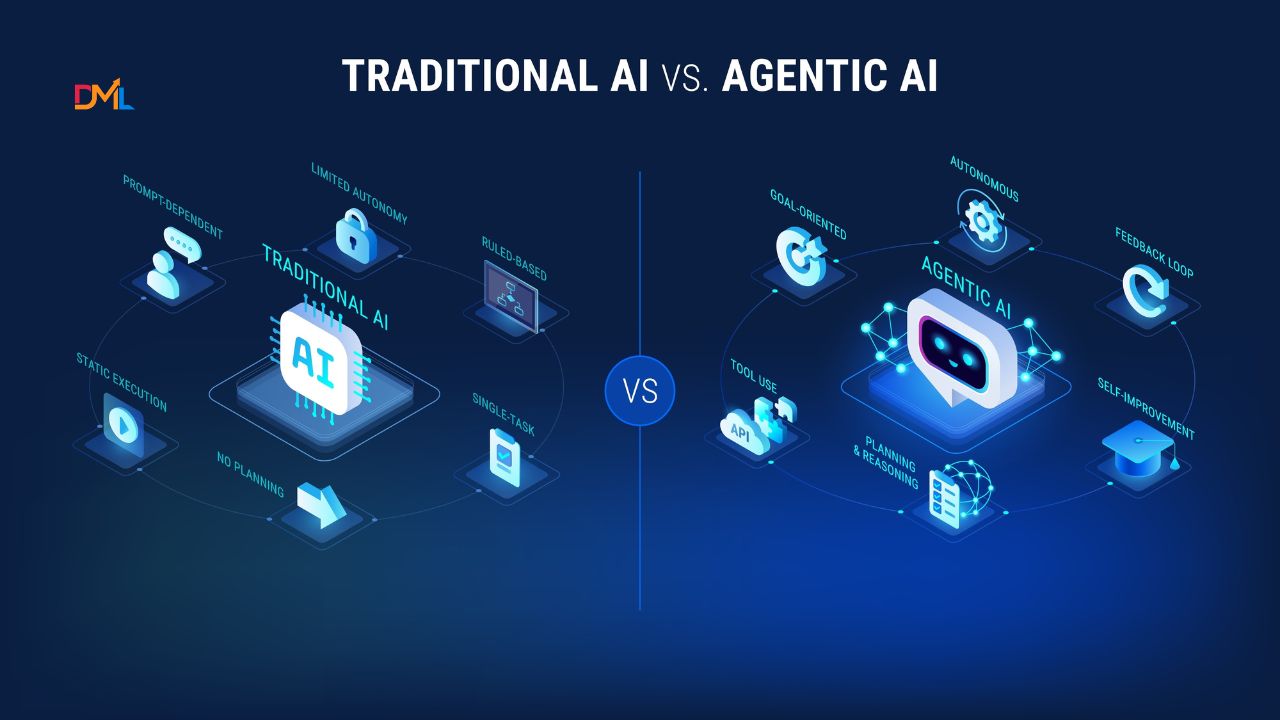
Conventional AI (the kind we generally mean when we say AI, or also ‘narrow AI’) is essentially built to carry out defined tasks based on either given rules, the patterns found in data, or models trained on such data. They perform well in conditions with clearly defined goals.
For example:
- Email spam filters
- Product recommendation engines
- Voice assistants
- Fraud detection systems
- Predictive analytics dashboards
These are incredibly powerful but they tend to work within set parameters. Classic AI receives input; processes it based on what it has been taught it’s suppose to be doing and provide output.
Consider a customer service Chatbot. A traditional AI Chatbot can answer common questions like:
- “What are your business hours?”
- “Where is my order?”
- “How can I reset my password?”
But if the user asks something unexpected or complicated, it might fail or divert the question to human support.
Traditional AI works best when:
- Tasks are repetitive
- Data is structured
- Rules are clearly defined
- Human supervision is available
In short, traditional AI is intelligent, but reactive.
What Is Agentic AI?
Agentic AI expands on the concept of AI further. Rather than being passive at a command it can plan, reason, learn and act by it in order to achieve goals.
Think of Agentic AI as a digital agent rather than just a tool.
An Agentic AI system can:
- Understand objectives
- Break goals into smaller tasks
- Make decisions
- Learn from outcomes
- Adjust strategies in real time
- Interact with multiple systems autonomously
For example, imagine you ask an Agentic AI assistant:
“Plan a three-day business trip to New York within my budget.”
Instead of only suggesting flights, the AI could:
- Search for flights
- Compare hotel prices
- Check your calendar
- Recommend meeting schedules
- Book reservations
- Optimize travel routes
- Adjust plans if delays occur
All with minimal human involvement.
This level of autonomy is what separates Agentic AI from traditional systems.When creating content around complex topics like Agentic AI, clarity and structure matter as much as the idea itself. A simple Word Counter can help writers, marketers, and businesses keep their explanations concise, readable, and aligned with platform requirements. Whether you are drafting blogs, reports, AI prompts, product descriptions, or website copy, tracking word count helps maintain focus and avoid unnecessary repetition. It is especially useful when simplifying technical subjects, where too much detail can confuse readers. Using a word counter ensures your content stays clear, balanced, and easy to understand.
The Core Difference: Reactive vs Proactive
The biggest distinction between the two lies in behavior.
Traditional AI = Reactive
It waits for instructions and performs a predefined action.
Agentic AI = Proactive
It understands objectives and independently works toward achieving them.
Traditional AI follows rules.
Agentic AI pursues goals.
This seems a little like an insignificant distinction, but in actual experience, the feeling is quite distinct.
Key Differences between Agentic AI and Traditional AI
1. Decision-Making Ability
The traditional approaches to AI have focused on pre-programmed logic and trained datasets. It does not truly “decide” beyond its predefined framework.
Agentic AI, however, can evaluate situations, consider multiple pathways, and select actions dynamically.
For example:
- Traditional AI: Detects low inventory
- Agentic AI: Detects low inventory, contacts suppliers, compares prices, places orders, and updates forecasts
This ability makes Agentic AI far more useful in complex business environments.
2. Adaptability
When things change, a traditional AI system needs to be retrained or manually tuned.
Agentic AI, on the other hand, has an ability to learn over time.
If the behavior of the client changes or if something in the market changes or anomaly occurs then Agentic AI can change the strategy dynamically without having to be updated by developers.
This type of elasticity is a key attribute in industries such as:
- Finance
- Healthcare
- Logistics
- E-commerce
- Cybersecurity
3. Goal-Oriented Thinking
Traditional AI is task-based.
Agentic AI is outcome-based.
For instance:
- A Traditional AI marketing tool may draft subject lines.
- An Agentic AI marketing assistant could potentially analyze campaign performance, strategies, plan and schedule and analyze campaign results, optimize the copy for next time all with no human involvement.
The purpose of Agentic AI is to resolve the whole problem not just part of it.
4. Human Involvement
Standard AI requires a person to be overseeing at all times.
Agentic AI reduces dependency on manual intervention by operating with a higher level of autonomy. With that shift in mind, developing an AI Strategy for small Businesses becomes increasingly important as organizations focus more on outcomes than day to day task execution.
This does not mean humans become irrelevant. Humans instead of task-management can instead work at the level of goals and ethic and just supervision.
Businesses could use their minds to greater use of strategy and creativity instead of monotonous processes.
5. Learning and Memory
Most traditional AI systems are trained once and updated periodically.
Agentic AI can continuously learn from:
- User interactions
- Real-time data
- Feedback loops
- Environmental changes
This ongoing learning process allows it to improve performance over time without constant retraining.
Real-World Applications
Traditional AI in Action
Traditional AI still powers many successful systems today.
Examples include:
- Netflix recommendations
- Google Translate
- Facial recognition
- Predictive maintenance software
- Automated fraud alerts
These applications are incredibly useful but generally narrow in scope.
Agentic AI in Action
Agentic AI is emerging in more advanced scenarios.
Examples include:
- Autonomous business assistants
- AI research agents
- Intelligent workflow automation
- AI software developers
- Self-managing cybersecurity systems
- Autonomous customer support agents
In a modern enterprise, Agentic AI is able to orchestrate across different departments, tools and workflows, completing bigger business tasks with low supervision.
Why Businesses Are Interested in Agentic AI
The rising interest in Agentic AI isn’t only about advancement; it is also about efficiency and scalability.
Companies are under constant pressure to:
- Reduce operational costs
- Improve customer experiences
- Increase productivity
- Respond faster to market changes
Traditional AI helps automate isolated tasks.
Agentic AI helps automate entire processes.
A distinction like that can improve business results.
This leads to:
- Faster decision-making
- Reduced human error
- Better resource allocation
- Enhanced personalization
- Continuous optimization
For online businesses, visibility is just as important as automation. A strong eCommerce SEO strategy helps product pages, category pages, and visual content appear in front of the right audience at the right time. As AI continues to improve how businesses personalize experiences and manage workflows, SEO ensures those improvements can actually reach potential customers through search. From optimized product descriptions to better image visibility and user-focused content, eCommerce SEO supports both traffic growth and conversion opportunities. For brands using AI-driven tools, combining automation with search optimization can create a stronger digital presence.
Challenges of Agentic AI
While there are benefits, there are also downsides of Agentic AI.
1. Trust and Reliability
The Agentic AI must operate and act in a way that can be trusted. Organizations must trust the Agentic AI is capable of operating safely and securely.
2. Ethical Concerns
The issue of responsibility and fairness is becoming more profound with agentic AI. Questions of transparence, blame, and bias have to be addressed as the AI will be working autonomously.
3. Data Security
The agentic AI often interacts with different systems and is a high source of information that is very important to the company, therefore security issues come into consideration in higher degrees than with traditional AI.
4. Complexity
Building and developing autonomous systems requires advanced technical systems and human capital.
Because of these difficulties, many businesses will introduce agentic AI gradually instead of replacing traditional AI systems with agentic ones instantly.
The Future of AI
Traditional AI is not going anywhere any time soon either-it continues to be a critical tool for clearly defined, highly predictable tasks.
Agentic AI however, is the next stage of evolution.
As AI becomes more autonomous, collaborative and context-aware, businesses will transition from basic automation to intelligent orchestration.
We anticipate the following in the next few years:
- AI agents managing business operations
- Personalized autonomous assistants
- Self-improving enterprise systems
- Multi-agent systems cooperative ecosystems
The change won’t transform the underlying technology but rather the way in which humans interact with smart machinery.
Final Thoughts
At its heart, the main difference between Agentic AI solutions and the traditional forms of AI is a simple concept: autonomy.
Traditional AI follows instructions.
Agentic AI pursues objectives.
Both techniques have merits, but address different domains. Classical AI is suited for automation of repetitive tasks whereas Agentic AI will tackle dynamic goals, complex reasoning and autonomous action.
For businesses, it is very important to have an idea about this difference. These companies, who are able to combine the trustworthiness of old-school AI with the flexibility of Agentic AI, would drive the next wave of digital transformation.
| About Author Sandy Adams is a qualified content writer with experience in writing on a variety of subjects. He has written a lot of content on AI Workforce and Agentic AI Solutions, digital services as well. |