



The choice between custom marketing software and pre-made solutions is crucial in determining the effectiveness of a company’s campaign management, customer data handling, automation, and analytics. While pre-made solutions offer rapid implementation and established features, custom software gives some flexibility in terms of customization and control.
So which option suits better? The answer to that will depend on the company’s marketing operations, budget, tech stack, and future objectives.

What is custom marketing software?
Custom marketing software is created to meet specific needs and functions of an organization. Marketing processes can now be made according to the desired work style of a company rather than under existing systems.
This software can provide:
- Campaign and marketing automation
- CRM functions
- Customer data management
- Lead scoring and segmentation
- Marketing analytics and reporting
- Customized customer experience
- Advices based on AI technology
- Integration with local and external systems
One of the most important features here is flexibility. The company chooses what to implement, what to connect, and how to evolve the program. For businesses that need more advanced capabilities, an AI-assisted development company can also help design and build solutions tailored to specific marketing workflows.
What are off-the-shelf marketing tools?
Off-the-shelf marketing tools refer to ready-made solutions meant for a wide variety of businesses, including CRM systems, email marketing tools, analytics software, social media management programs, and marketing automation systems.
Companies typically buy a subscription, set up the software, and put it into operation in no time.
These solutions are most effective when a business has common marketing needs that available technologies can already fulfill.
Custom marketing software vs off-the-shelf tools
The contrast between the two forms starts becoming apparent when it comes to a direct comparison.
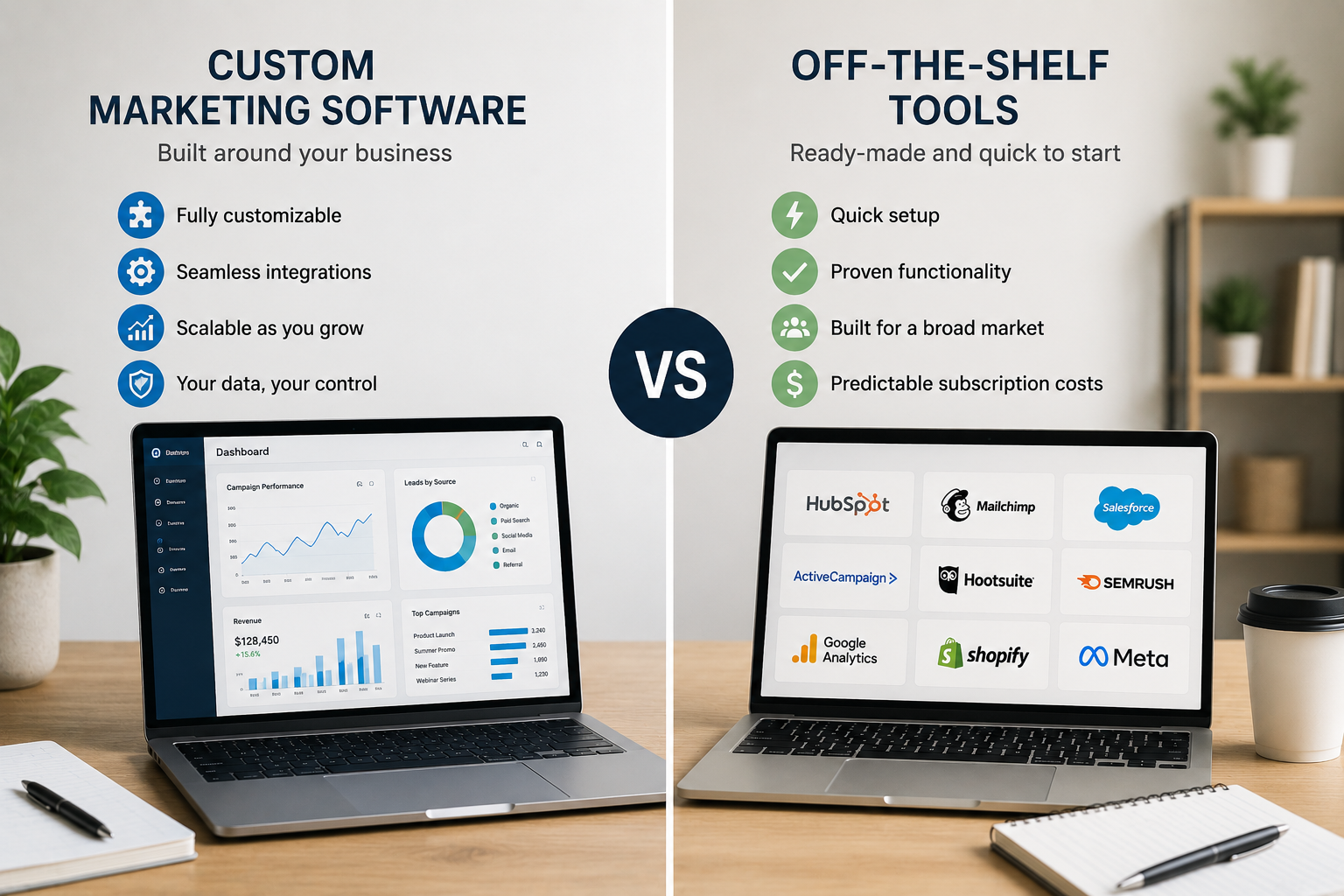
| Factor | Custom software | Off-the-shelf tools |
| Implementation | Longer | Faster |
| Initial cost | Higher | Lower |
| Customization | Extensive | Limited |
| Integrations | Built around your ecosystem | Depends on available integrations |
| Scalability | Tailored to business growth | Depends on vendor capabilities |
| Ownership | Business controls the solution | Vendor controls the platform |
| Maintenance | Requires ongoing development | Usually handled by vendor |
| Workflows | Designed around your processes | Based on predefined workflows |
Both approaches have their pros. The important question is whether the conventional software is viable for your processes without introducing unnecessary restrictions.
Advantages of custom marketing software
Custom marketing software enables organizations to enjoy increased control, flexibility, and scalability by aligning technology with specific marketing objectives and processes.
Custom functionality. Custom software can replicate any marketing operation, approval process, customer journey, and business rules, which means that employees do not need to modify their operations according to predetermined functions.
Better integration. Marketing data can be found in CRM, ERP systems, web pages, mobile applications, analytical systems, advertising platforms, and local databases, and custom software can link all these data sources and allow for their integration.
Enhanced automation. Companies are able to automate their operations according to their rules, customer needs, and operational requirements instead of using generic automation scenarios.
Increased control. Companies have the capacity to control their product strategy and define new capabilities whenever they need to change their marketing strategy.
On the other hand, custom software development requires large upfront payments, prolonged implementation, and post-implementation support.
In modern marketing ecosystems, high-performing Web Applications serve as the backbone for connecting fragmented digital touchpoints. By leveraging cloud infrastructure and smart APIs, these customized platforms seamlessly sync user interactions across multiple marketing channels in real time. Rather than struggling with disconnected data silos, organizations can build centralized digital hubs that streamline data capture, enhance user journeys, and scale efficiently alongside rapidly evolving business needs and technological shifts.
The advantages of off-the-shelf marketing solutions
The main benefits of ready-made marketing systems are their quickness and availability.
Companies can take advantage of ready-made technology, and they do not need to develop their service themselves. Moreover, the vendor assumes the responsibility for maintenance and security.
Off-the-shelf solutions are a very good choice when:
- The marketing demands are more or less standard
- Quick implementation needed
- The budget is limited at the beginning
- The current integrations meet the companies’ requirements
- Custom solutions do not offer the company any competitive advantage
One of their main disadvantages is their inflexibility. Once the company grows, it can face problems regarding processes, integrations, and pricing.
At what time should one consider developing customized marketing software?
Custom development is needed when common tools create barriers in operations.
Some of the common indicators for this include:
- Dependence on Excel sheets and manual operations.
- Presence of disconnected customer/marketing data.
- Existing integration options are not able to organize a quick flow of the needed data.
- Regular software will fail to deliver some crucial workflows.
- SaaS costs will become excessive due to scaling.
- Need for proprietary analysis, automation, or personalization.
- Moreover, marketing technology becomes a key competitive differentiator.
In those situations, there is a need to develop a custom function.
When is it appropriate to utilize off-the-shelf tools?
It is typically best to purchase off-the-shelf software where the business problem is widely understood and there are many reliable existing solutions.
A firm that wants to execute basic email campaigns, has simple CRM needs and requires marketing analytics may have no need to create the components on its own.
Using pre-existing technology permits the firm to become operational more quickly and to apply its resources in alternative areas.
Use a hybrid strategy
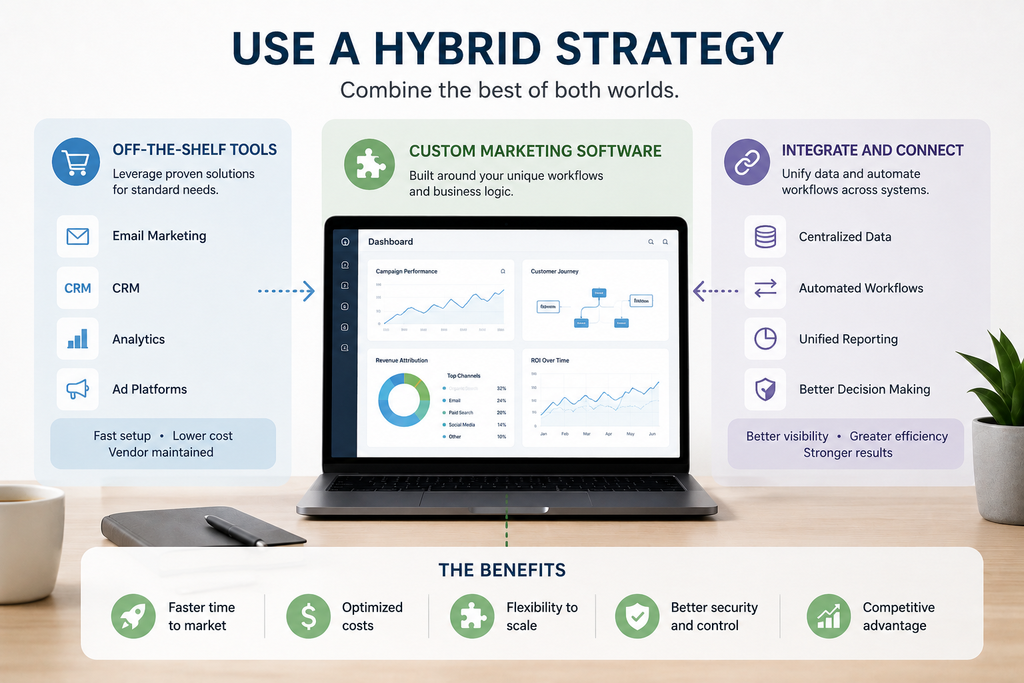
The decision can be made by the organization without facing the dilemma of building everything from scratch or buying a ready-to-use solution.
Companies already using them know the advantages of using existing platforms that are less flexible for their processes.
They can utilize the existing CRM, advertising, and email systems while working on customized software that will integrate data from these systems, automate their internal processes, and provide consolidated reporting.
For specialized search engine optimization, relying on a dedicated Google Index Checker is far more efficient than building bespoke tracking systems from scratch. These pre-built utilities instantly verify URL indexing status, detect crawl issues, and help maintain organic search visibility without ongoing development overhead. Incorporating such tools into a broader hybrid marketing stack lets teams resolve critical SEO tasks quickly, saving valuable engineering resources for custom automation and complex analytics workflows that truly require unique internal development.
The hybrid solution helps companies to profit from ready-made solutions of other producers without losing customization.
Custom versus ready-made marketing solutions: conclusion
In the end, it all comes down to a certain situation.
Ready-made marketing software is often preferable when the needs of a business are simple, the budget is tight, and the speed of delivery is important. Custom solutions work better when the processes to be automated are complicated, the integrations matter, or the existing solution cannot satisfy the long-term requirements of the business.
It is always better to analyze the existing processes, integration needs, scalability expectations, and how much technology will cost.
In a lot of cases, the best solution is to just get the basic functionalities and create what will make your marketing operations special.