




Marketing analytics has left the time of merely providing information on clicks, impressions, and conversion rates behind. In 2026, the pressure on businesses to comprehend what has happened and to figure out why, which actions are useful and contribute to revenue, and what to do with the next marketing dollar is increasing.
The evolution of artificial intelligence, modifications to privacy, customer journeys being increased in their complexity, and the significance of first-party data are causing the changes in how organizations define and assess their performance. In the 2026, IAB states that AI is going to serve as a standard marketing performance measurement tool rather than remain an experimental tool. Let’s look at some of the marketing analytics trends to keep in mind.
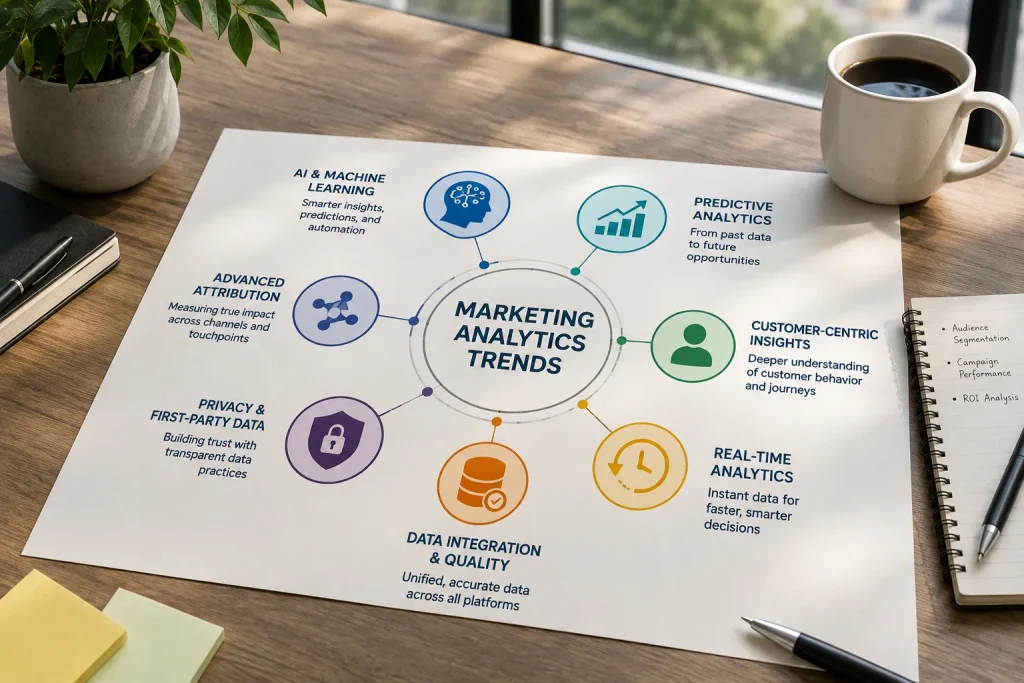
1. AI-Powered Analytics Becomes Standard
Artificial intelligence is becoming more integrated into marketing analytics as time passes. Marketers no longer need to review reports manually; instead, they can use AI-powered systems to analyze patterns, detect unusual performance changes, generate forecasts, and identify potential optimization opportunities.
What is more important is the transition from descriptive analytics to predictive and prescriptive analytics. Companies are looking for answers to questions such as which customers are most likely to make a purchase, which campaigns require more investment, and which audience segments are expected to generate the highest value. In many cases, a business intelligence consultancy can help organizations connect these analytics capabilities with broader reporting, data integration, and decision-making processes.
As these capabilities continue to develop, analytics professionals will spend less time collecting data and more time validating insights and making strategic decisions. AI is also changing how organizations understand and improve audience experiences across different environments. Beyond traditional marketing campaigns, businesses and institutions are using intelligent technologies to personalize interactions, analyze behavior, and identify what keeps audiences engaged. Similar approaches are being applied to Visitor Engagement in museums, where AI can help create more personalized and interactive experiences. These developments show how analytics and AI are increasingly influencing engagement strategies across a wide range of industries.
2. Marketing Mix Modeling Makes a Comeback
The conventional attribution process is increasingly difficult because customer journeys encompass numerous channels including offline ones, the internet, and applications.
This is why Marketing Mix Modeling (MMM) is coming into focus again. It is a method that uses a large pool of historical data to evaluate marketing influences on business results.
These days, modern methods are becoming more accessible. For instance, Google has integrated its open-source Meridian Marketing Mix Model with Google-Analytics 360, making it possible to analyze data across channels and use causal methods.
Thus, it can be anticipated that businesses will apply a combination of attribution, MMM, and experimental approaches instead of relying on any one of them only.
3. Incrementality Matters More Than Attribution
The fact that a customer saw an ad before making a purchase does not imply that the ad had caused that purchase.
Such a clear difference has brought the notion of incrementality testing into the forefront of discussions about marketing analytics. Instead of asking the question of what advertising channel deserves credit for the sale, marketers have started inquiring whether the sale would have occurred without the campaign.
The 2026 initiatives of IAB concerning measurement make incrementality testing, outcome measurement, and more advanced MMM methods critical directions for enhancing marketing measurement.
It allows companies to enhance the quality of assessments of marketing ROI and to avoid unnecessary expenditures on campaigns generating conversions without driving real demand.
4. First-Party Data Becomes More Valuable
The importance of first-party data collected via websites, applications, CRM systems, subscriptions, purchases, and customer interactions is only increasing.
Experian informs that 70% of B2B organizations plan to use more first-party data in 2026.
However, simply gathering more data is not enough since many companies still have fragmented customer data from different CRM systems, advertising tools, analytics platforms, and online shops.
The priority now is on data unification and establishing the infrastructure for joint analysis of marketing, sales, product, and customer data.
5. Privacy-Aware Measurement Evolves
Access to traditional tracking signals continues to be impaired by privacy requirements and platform restrictions.
Analytics platforms are adapting to these changes. For instance, Google changed how Google Analytics and Google Ads process certain advertising data in June 2026, which means that Consent Mode has a much bigger contribution to the way ad data is collected and utilized.
Thus, businesses will need to develop measurement strategies that are not based so much on individual tracking anymore, but rather on consent-based first-party data, modeling, experiments, aggregated insights, and privacy-friendly infrastructure.
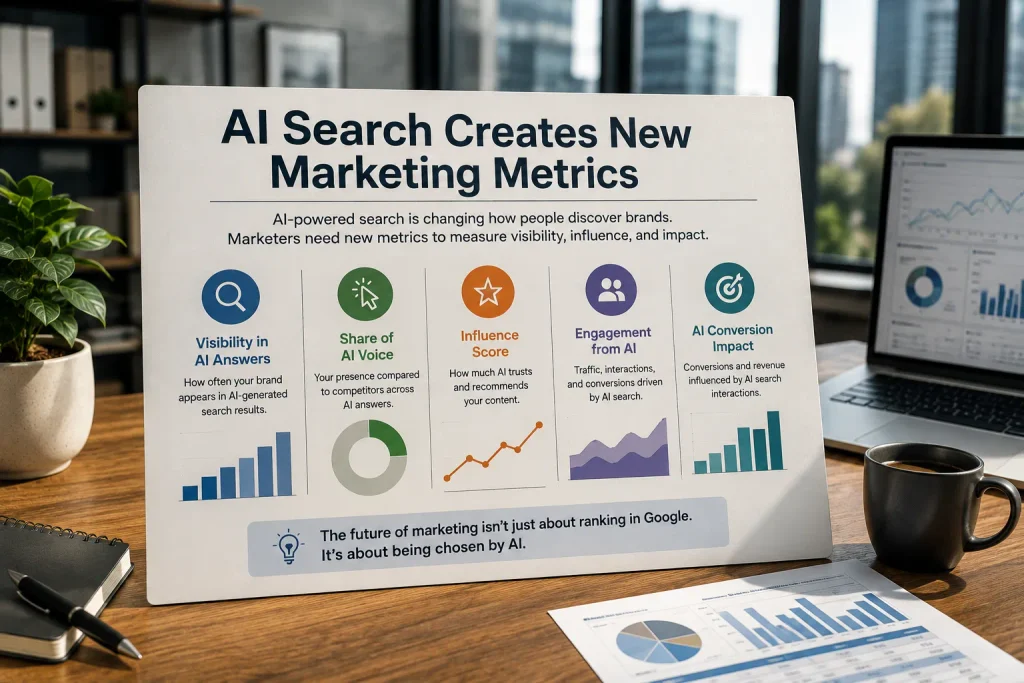
6. AI Search Creates New Marketing Metrics
The generation of AI-based solutions has created yet another measurement problem.
The potential buyer can now gather information regarding the products through the AI assistant without browsing through multiple websites or clicking through conventional search results. As IAB notes, the journey of the customer can now be confined to artificial intelligence discussions allowing invisible traditional variables like sessions, clicks, and pageviews.
As a result, new metrics are being developed within the context of AI visibility and include the mention of the brand, its prominence, and representation. Content consumption is also becoming less dependent on traditional website sessions. Audiences may discover videos through search engines, social platforms, or AI assistants and consume that content in different formats. For example, tools such as a YouTube Video Audio Downloader allow users to access video or audio content outside the original platform experience. These changing consumption patterns make it increasingly important for marketers to look beyond clicks and pageviews when evaluating content reach and audience engagement. IAB issued the guidelines for the measurement of AI visibility in August 2026 as this area goes on developing.
7. Analytics Shifts From Channel Metrics to Business Outcomes
The teams involved in marketing have been optimizing the channels separately. The focus of paid search is around ROAS, while for social media it is about engagement and for email it revolves around open rates and click-throughs. However, that trend is slowly fading away.
Now, companies want to measure the result, linking it with something more meaningful, for example revenue, profits, customer acquisition cost, customer retention rate, customer lifetime value, etc. In the same way, IAB’s 2026 NewFronts are targeting the same change of the industry from the impression-based approach to a more accountable one. This pushes the teams to start looking at marketing as a coherent whole rather than at disconnected channels.
Concluding Remarks
In 2026, marketing analytics is witnessing the trend of widened use of predictive technologies, respect for privacy, and focused studies on outcomes. Artificial intelligence can speed up analytics processes; however, proper measurements depend on strong data infrastructure and the application of appropriate methods.
Companies that combine first data sources with incrementality testing, marketing mix modeling, AI-assisted analysis, and business-level KPIs are in a better position to understand what affects growth and not just what brings the highest measurable results.




How 3D Sensors and AI Are Transforming Real-Time Data Analytics
September 16, 2026[…] […]