

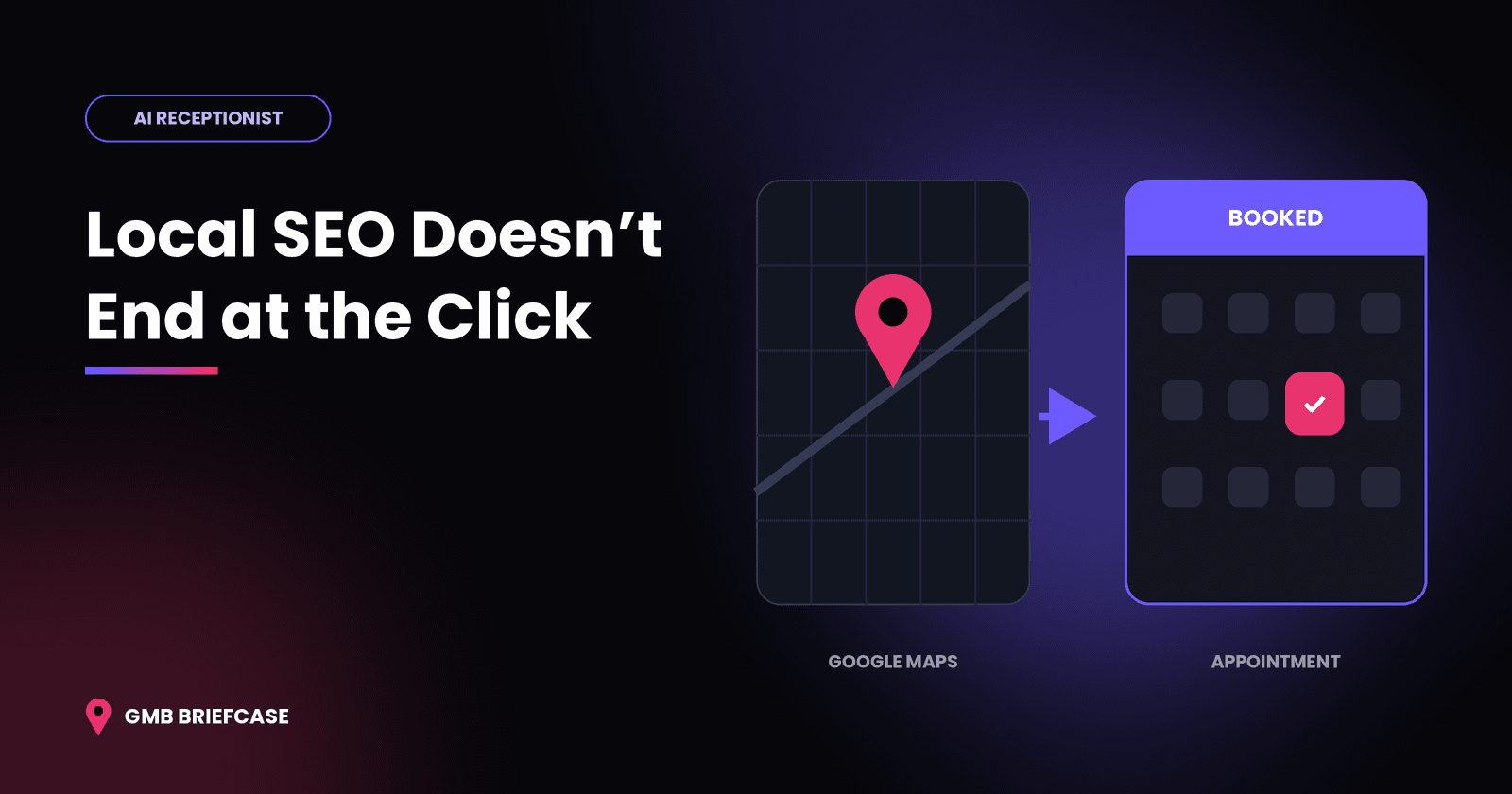
Quick answer: Local SEO delivers visibility, clicks and calls, but revenue only arrives when someone answers the call and books the job. The step after the click, often the phone, is where many local businesses lose the customers their rankings earned. Closing that gap with fast answers, accurate hours and automated booking turns local search visibility into appointments.
The funnel everyone stops measuring halfway
Local SEO reports usually end with rankings, impressions, website clicks and call clicks. Those matter. But the customer’s journey does not end with the tap on “Call”. A tap is a promise to talk to someone. If the phone rings out, the journey sends the customer to the next listing.
The full path has five steps: the search, the listing view, the call or visit, the conversation and the booking. Most local SEO work covers the first three. Revenue happens in the last two.
Why success makes the problem bigger
There is an uncomfortable effect in local marketing: the better the SEO, the more calls arrive, and the more calls are missed if the phone is not covered. A business that jumps from page two to the top three on the map may double its call volume. If it cannot answer them all, the improvement partly leaks away.
People searching on a phone are close to a decision. They want an answer now. In a CallRail survey cited by Aloware, 82% of consumers said they would call a competitor if a business did not pick up. For a Google Maps visitor, the competitor is one tap away.
The five leaks after the click
1. Wrong hours. If the Google Business Profile says open and the shop is closed, the caller reaches no one, and may leave a review about it.
2. Unanswered calls at peak times. Lunch breaks, busy mornings and counter rushes all leave the phone unattended.
3. Calls outside opening hours. A shop open only part of the week misses most of the week by default.
4. Slow answers to simple questions. People call to ask about price, location and availability. A caller kept waiting will try someone else.
5. No path to booking. Even an answered call can fail if the person cannot book a time without another round of calls.
Fixing the gap, step by step
Audit the profile. Check hours, holiday hours, phone number, service list and booking link. Make sure each matches reality.
Make a test call. Ring the listed number at midday, in the evening and on a Sunday. Note what happens.
Answer every call. Use staff, an answering service or an AI receptionist to pick up each call, including those after hours. The AI option answers, qualifies and books without adding headcount.
Book instead of promising callbacks. Connect the phone line to a calendar so callers leave with a confirmed time.
Close the loop with reviews. Ask satisfied customers for a review after the appointment, which feeds the rankings that produced the call.
What to measure instead
Add conversion metrics to the traditional report:
| Stage | Metric |
|---|---|
| Visibility | Map and search impressions |
| Interest | Call taps, website clicks and direction requests |
| Answering | Percentage of calls answered, including after hours |
| Conversion | Appointments booked from calls |
| Reputation | New reviews after appointments |
The fourth row is the one most reports lack, and it is the one clients pay for.
What agencies can do
Agencies that manage local SEO are well placed to own this part. They already control the listing that generates calls, so they can recommend and manage the layer that answers them. That might be a human receptionist, an answering service or a voice AI receptionist that handles routine calls and books appointments around the clock. The result is a report that shows leads and appointments, not just rankings.
A quick example
Imagine a physiotherapy clinic that ranks in the top three for “physio near me”. Call taps go up 40% in two months. But half the new calls arrive during treatment sessions or after 6 pm, and go to voicemail. With an AI receptionist covering those calls, each one is answered, the caller’s problem is noted and a slot is booked. The ranking was always capable of producing those patients. The phone just needed answering.
FAQ
Does local SEO lead to phone calls?
Yes. For many local services, calls from Google Maps and the Business Profile are the main conversion.
Why do missed calls matter for local SEO?
A missed call usually means a lost customer, and the visibility that earned the call is wasted.
How can a local business turn Google Maps visitors into bookings?
Keep the profile accurate, answer every call, including after hours, and let callers book directly, for example through an AI receptionist connected to a calendar.