



Innovation in the insurance industry is happening faster than ever before due to artificial intelligence (AI) and the use of Big Data technologies. The move away from traditional methods and models of insurance means that companies want to make faster decisions regarding their policies, offer better service to their customers, and manage risk more effectively by relying on data-driven solutions.
Insurance providers today are utilizing Automatic Machine learning, predictive analytics, and automated processes, all having an impact on the improvement of their business process efficiency, fraud detection and customer experience; because of the changing demands of their Customers, Insurance Software Development is now focused on the incorporation of both AI and Big Data into the Digital Platforms and Core Operations of most Insurers.
Through this article, you will see how these two technologies are having an impact on Insurance Software Development, and how they are helping drive innovation within the Insurance Industry.

The Increasing Impact of Artificial Intelligence and Big Data within the Insurance Industry
Insurers create and process massive quantities of data every day such as:
- Customer profiles
- Claims history
- Policy details
- Data from IoT / telematics
- Medical records
- Financial transactions
- Behavioral / social information
Previously, only a fraction of the available data was leveraged since processing limits prevented insurers from taking full advantage of all data. Today, AI algorithms, big data infrastructures, and modern insurance software development services allow insurers to derive valuable insights almost immediately.
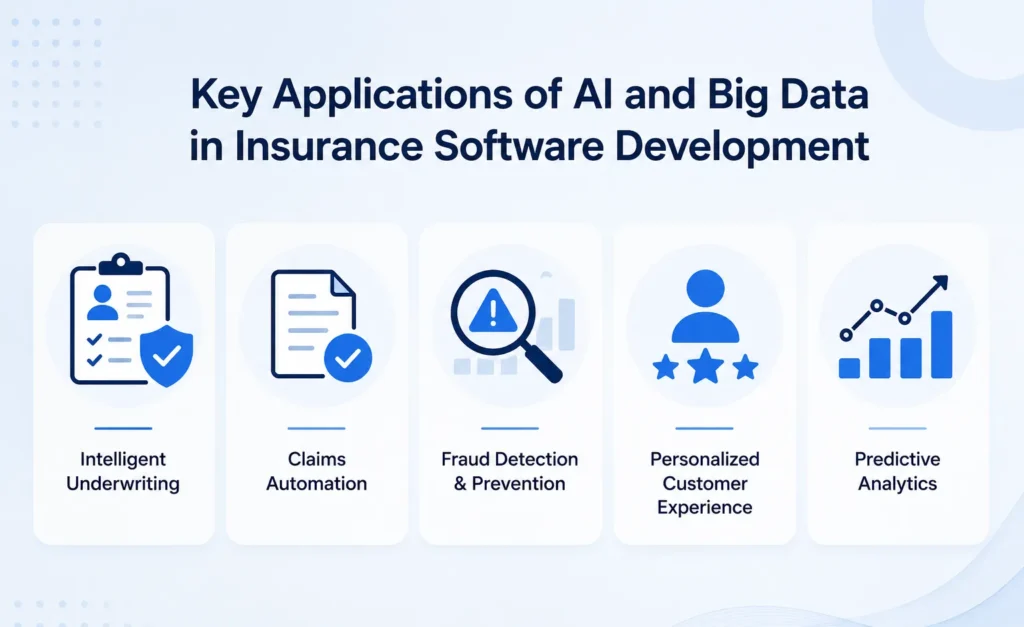
AI & Big Data Key Applications in Insurance Software
Artificial intelligence and big data are making an impact on the majority of areas within the insurance business. From underwriting through customer service, these two technologies are changing how we create and implement insurance software solutions.
Underwriting and Risk Assessment Powered by AI
Instead of using static historical data and manually reviewing applications, traditional underwriting relies heavily on these antiquated methods. Using an AI-based approach, underwriters can process large amounts of data in real time to make better decisions regarding potential risks.
Advantages of Smart Systems for Underwriting
Automated underwriting solutions offer several advantages compared to using a traditional method, such as:
- More accurate risk assessment.
- Faster processing of applications.
- Identifying previously hidden patterns of risk.
- More accurate pricing.
For example, telematics data from vehicles, medical records from wearables, or home sensors can all be used by machine learning programs to create up-to-date risk profiles.
Big Data Types of Sources That Are Used in Underwriting
Software is being created by insurance companies that use multi-source data from:
- Internet of Things (IoT) devices.
- GPS and telematics.
- Electronic medical records.
- Credit scoring.
- Weather.
- Social media.
- Smart home devices.
By leveraging these resources, insurers can provide very customized offerings for their customers who purchase insurance.
Automation for Claims Processing
Claims management is one of the most resource-intensive areas in insurance operations. AI-powered software solutions are streamlining claims handling through automation and intelligent analytics.
The Improvements That AI Can Bring to Claims Management
Insurance applications that utilize artificial intelligence benefit from the following:
- Automatically authenticate claim information
- Analyse claim documents through the use of OCR and..(auto correct)?
- Estimate damage amounts using computer vision
- Identify fraudulent claim trend(s)
- Place urgency on overdue claims
- Accelerate the timelines to settlement
Recent examples of image recognition algorithms can be used to establish the amount of damage to a vehicle as identified by an uploaded image – thereby removing the need for individual inspections.
Rapid Response (Customer Service) Through Automation
AI powered chatbots and virtual assistants help insured individuals with submitting claims; checking the status of their claim; and providing assistance 24/7 on any issues related to the claim they submitted, Improved customer satisfaction and reduction of the insurance administrators’ workload results from utilising the capabilities of both AI chatbots and virtual assistant to provide assistance to the insured.
Detection and Prevention of Fraud
Insurance fraud is still one of the biggest financial burdens for Insurance providers. However, reliance on AI and Big Data Analytics has empowered…and given the empowered insurance industry to detect fraudulent activity with greater accuracy than traditional rule-based systems.
Machine Learning in Fraud Detection
AI-based models can analyze large quantities of transaction data and behaviour data effectively to identify behaviours that deviate from expected behaviours or statistically deviate from normal to identify potentially fraudulent behaviours.
Fraud detection systems using Machine Learning technology have the capacity to detect:
- Duplicate Claims
- Identity Fraud
- Suspicious Billing Activity
- Organized Fraud Networks
- False Claims of Injury
Machine Learning based fraud systems learn continuously through the processing of new information and will become more accurate in fraud detection over time with the introduction of additional data to machine learning.
Real-time Fraud Monitoring
Big Data based systems in infrastructure will enable fraud analysis to occur in real-time, allowing immediate alerts of potential fraud and will expedite the investigation of fraudulent activities as they become available.
Real-time detection of fraud activities will greatly improve the financial viability and operational integrity of Insurance providers.
Tailored Insurance Solutions and Experiences for Customers
With customized digital services being an expectation in all industries by consumers today, that same expectation exists in the insurance industry. Insurers can provide personalized policies and recommendations to individual clients through AI and Big Data; two tools that help insurers evaluate the client’s behavior as well as their unique risk profile.
Pay-As-You-Go Insurance
One of the most recent innovations in the insurance industry is pay-as-you-go insurance (also known as usage-based insurance or UBI) which allows for an individual’s premium to be calculated based on actual usage (real-time data).
Some examples of UBI include:
- Pay-How-You-Drive auto insurance
- Health insurance based on fitness activity
- Smart home insurance using IoT devices to monitor the home and its occupants
The common denominator for all three of these examples is that they rely upon continuous (real-time) data collected from the insured and analyzed using AI.
Customer Insights Created by AI
With advances in the capabilities of insurance software platforms, insurers can effectively analyze and evaluate client interactions, preferences, and behaviors to:
- Provide clients with appropriate policy recommendations
- Predict the likelihood of client attrition (customer churn)
- Improve retention strategies
- Create targeted marketing efforts
- Increase customer engagement
By harnessing the advancements in these areas, the insurance industry will create a customer-centric insurance environment.
AI Chatbots & Smart Customer Support
AI is also changing customer support within the insurance software market.
Advantages of AI for Customers
AI chatbots can:
- Provide answers to policy-related inquiries
- Help consumers to onboard to the service
- Help the consumer navigate through the claims submission process
- Offer instant quotes for new business
- Support the continued renewal of policies
The use of natural language processing (NLP) allows these AI service delivery models to have more human-like conversations and reduce the number of phone calls made to a live agent by the customer.
Businesses handling digital content and web-based communication often rely on automation tools to improve efficiency. Similarly, developers and marketers can save time by using a URL to HTML Link Converter to instantly transform plain URLs into clickable HTML hyperlinks without manual coding. This helps maintain clean formatting, improve productivity, and simplify content management workflows across websites and applications.
Omnichannel Customer Experience
Most modern day insurance applications deploy AI chatbots through multiple channels:
- Mobile applications
- Websites
- Messaging platforms
- Voice-enabled devices
Enabling consumers to have a consistent customer experience throughout the insurance process with a timely response.
Challenges of Implementing AI and Big Data in Insurance
The implementation of AI and Big Data into insurance software has a variety of challenges, even though numerous benefits exist to integrate these types of technologies into the insurance industry.
Data Privacy & Security
Since insurance companies store very sensitive customer data, it is critical for these companies to maintain a focus on both data security and adherence to regulations like GDPR, HIPAA, PCI DSS, and local insurance regulations as part of compliance standards.
It is also essential that developers use encryption, role-based access control, and staged/secure cloud architectures as part of their development processes.
Integration with Legacy Systems
Today, many insurance companies continue to operate in environments that rely on very old legacy infrastructure. As a result, there can be challenges associated with implementing new AI-driven technologies, namely:
- API Integration
- Cloud Migration
- Microservices
- Standardizing Data
When building modern insurance platforms powered by AI and Big Data, companies often evaluate outsourcing models to accelerate development while controlling costs. Understanding the differences between Nearshore vs Offshore development can help insurers choose the right collaboration approach based on budget, communication, time zone alignment, and technical expertise. Nearshore development typically offers smoother collaboration and cultural compatibility, while offshore development may provide larger cost savings and access to wider talent pools. Selecting the right outsourcing strategy is especially important for complex insurance software projects that require scalability, security compliance, and continuous innovation in rapidly evolving digital environments.
Ethics & Bias
When improperly trained or when training data is incomplete, training data can inadvertently introduce bias to insurance underwriting and/or claims decisions through the use of AI technologies.
Developers need to address this issue by assuring:
- AI models/technologies have transparency
- A network of ethical governance for AI operations exists
- A continual process for monitoring performance is in place
- A fair testing process exists to validate unbiased decision-making