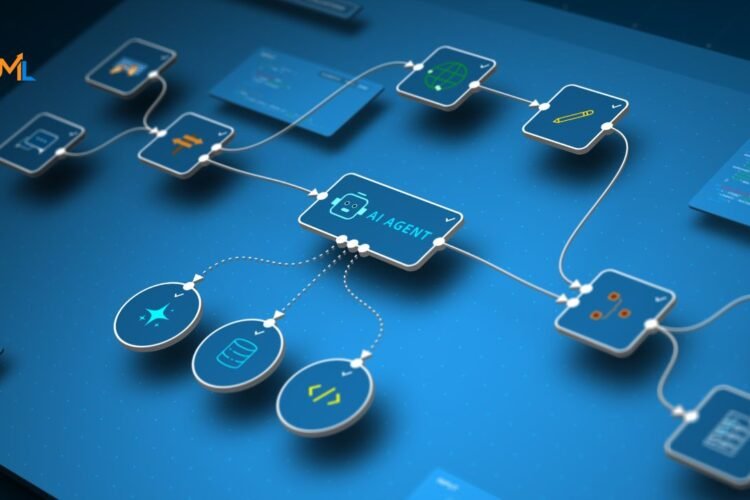



The method in which we are creating software has really changed due to Artificial Intelligence. There are many projects now that have an entire toolset for creating, maintaining, and using each component of the software development life cycle (SDLC).
A few examples would be creating (build), fixing (debug), providing documentation on the source code (documentation/ ARI/ CMR/ RPS) for future software developers (documentation) and verifying the functionality of the software through testing (test). As such, the use of AI tools to complete these tasks will enhance your productivity considerably; however, be sure to weigh the potential negatives before you start using an AI-supported software process.
The following article will discuss:
- The major benefits of AI-supported software development.
- The major downsides of using AI-supported software development.
- Recommended practices and procedures for implementing an AI-assisted development process.

Defining AI-Assisted Development
In broad terms, AI-assisted development refers to the application of machine learning models (primarily large language models (LLMs)) to support or automate various portions of the software development lifecycle, a capability often leveraged by a generative AI development services company. Common examples of how these applications can be used include:
- Creating code snippets or complete functions
- Suggesting improvements and/or refactoring existing code
- Implementing detection of software bugs and security vulnerabilities
- Creating software documentation and testing processes
- Facilitating the learning of new software development frameworks/languages
In this context, AI supplements (and does not replace) developers by acting as an intelligent co-pilot to the developer and augmenting the capabilities of the human developer.
Benefits of AI-Assisted Development
There are many benefits to using AI to enhance the development of products. Here we will define and describe just the most important benefits.
Productivity Gains
The presence of AI helps developers to quickly make boilerplate code, get tips for finishing off their code, and automate repetitive activities. These advantages allow them to have a greater portion of time in development focused on problem-solving (higher level) compared to only performing work (routine tasks).
More Rapid Learning
AI helps software developers learn new technologies faster than they would on their own by providing guidance such as examples/comparisons when they ask for help. The primary benefit comes from onboarding or gaining proficiency with a new technology at an accelerated pace.
To further enhance productivity in modern workflows, many developers are now leveraging specialized AI Tools for Vue.js Developers that are designed to streamline frontend development. These tools assist with component generation, state management suggestions, debugging, and performance optimization tailored specifically for Vue.js environments. By integrating such tools into your workflow, developers can reduce repetitive coding tasks and focus more on building scalable and interactive user interfaces. If you’re working extensively with Vue.js, exploring dedicated AI-powered solutions can significantly improve both development speed and code quality while maintaining consistency across projects.
Code Quality is Enhanced by Correctly Utilizing AI
If used appropriately, AI can help to provide quality assurance parameters for developers through quality guidelines for coding, detection of issues and the creation of automated unit tests. A well reviewed project will produce higher quality products with a more manageable code base.
Risks and Challenges
AI-Assisted Development also has some disadvantages, which you can read about below.
- AI-generated code can be syntactically correct, but can have hidden bugs, inefficiencies, or legacy practices. Trusting AI output completely can cause significant problems.
- AI can create insecure implementations (such as inadequate input validation, using weak forms of encryption). Developers must continue to consider security throughout development.
- Excessive reliance on AI can lead to a decline in basic programming skills for newer developers who may be skipping the basic learning process.
- Many AI models are trained using publicly available code, which may contain source-licensed code. Thus, there may be a risk of legal and compliance issues.
- AI has no way to have context about your system architecture, business logic, or constraints; its output may not fit the needs of your project.
Best Practices for Using AI for Development
When using AI-Assisted Development, the following best practices should be followed:
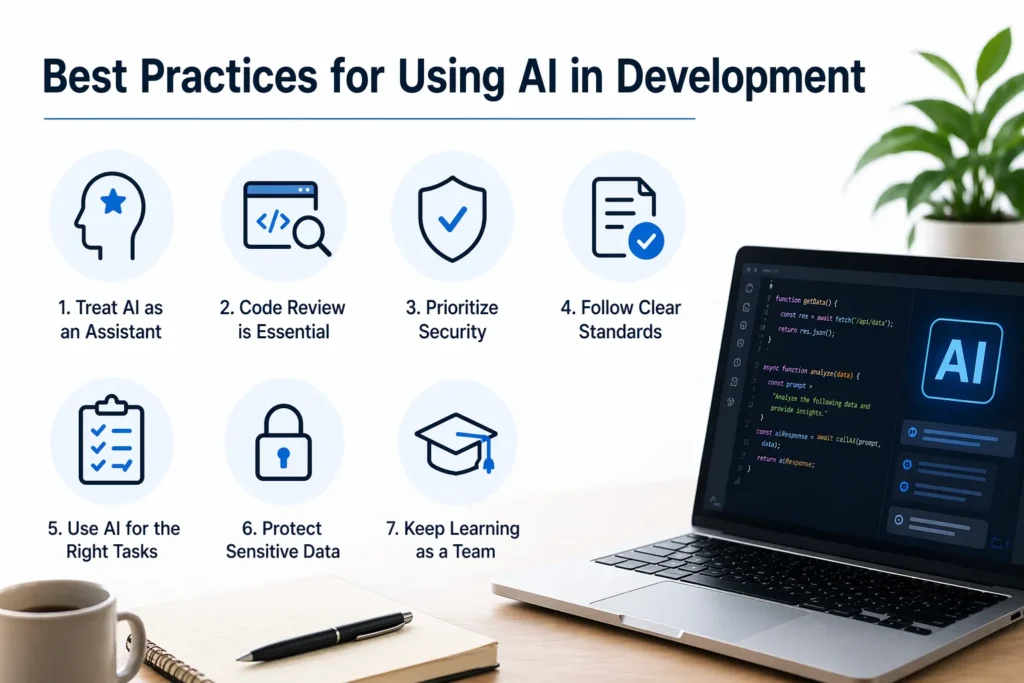
1. Treat AI as an Associate, not as an Authority
Code generated by an AI should always be reviewed and validated. You should consider AI-generated code to be an additional, like an inexperienced assistant; generally fast, but not always correct.
2. Use Strong Code Review Processes
Human supervision is very important with AI-generated contributions. All AI-generated contributions should be submitted through a standard code review process.
3. Secure Your Applications Against Outside Attacks
When using AI-generated code, always run security scan and verify inputs based on a security coding standard as AI-generated code cannot be assumed to be safe by default.
4. Have a Defined Coding Standard
All code generated by AI should be consistent with the definition of the project’s architecture and coding style.
5. Use AI for Appropriate Solutions
AI is very effective at:
- Boilerplate code Generation
- Documenting
- Creating Test Cases
- And not so much for:
- Complex Architecture Decisions
- Writing Critical Security Code
6. Do Not Share Sensitive Information
Proprietary code, passwords/credentials or non-public information should only be shared with AI tools once you understood how the AI tools will treat that data.
7. Continuously Train Your Developers
Developers should be educated on the benefits and limitations of AI tools. Develop critical thinking and promote responsible use of AI tools.
AI-Based Development: Opportunities Ahead
Artificial intelligence is now integral to the development of software. With the evolution of AI tools, we expect to see much more integrated and sophisticated AI features built into Integrated Development Environments (IDEs), much more effective debugging tools, and much more autonomous workflows.
The truly successful teams will be those that find the correct balance between using AI for increased efficiency through its use, while still using sound engineering practices and human judgment.
As AI adoption grows across different domains, data professionals are also benefiting from specialized AI Tools for Data Scientists that streamline complex workflows. These tools help automate data cleaning, model selection, feature engineering, and even predictive analysis, allowing data scientists to focus more on insights rather than repetitive tasks. By integrating AI-powered solutions into their workflow, teams can accelerate experimentation, improve model accuracy, and handle large-scale datasets more efficiently. For organizations heavily reliant on data-driven decisions, leveraging the right AI tools can significantly enhance both productivity and analytical outcomes.
Final thoughts
The use of AI to assist in the development process has many benefits in terms of time, efficiency and ease of access. However, there are also potential risks associated with using AI that should not be overlooked. Teams can leverage the best of what AI can provide while at the same time keeping a critical eye on potential quality and security issues, if they practice sound judgement when using AI. Ultimately, AI enhances a developer’s ability to do their job.