



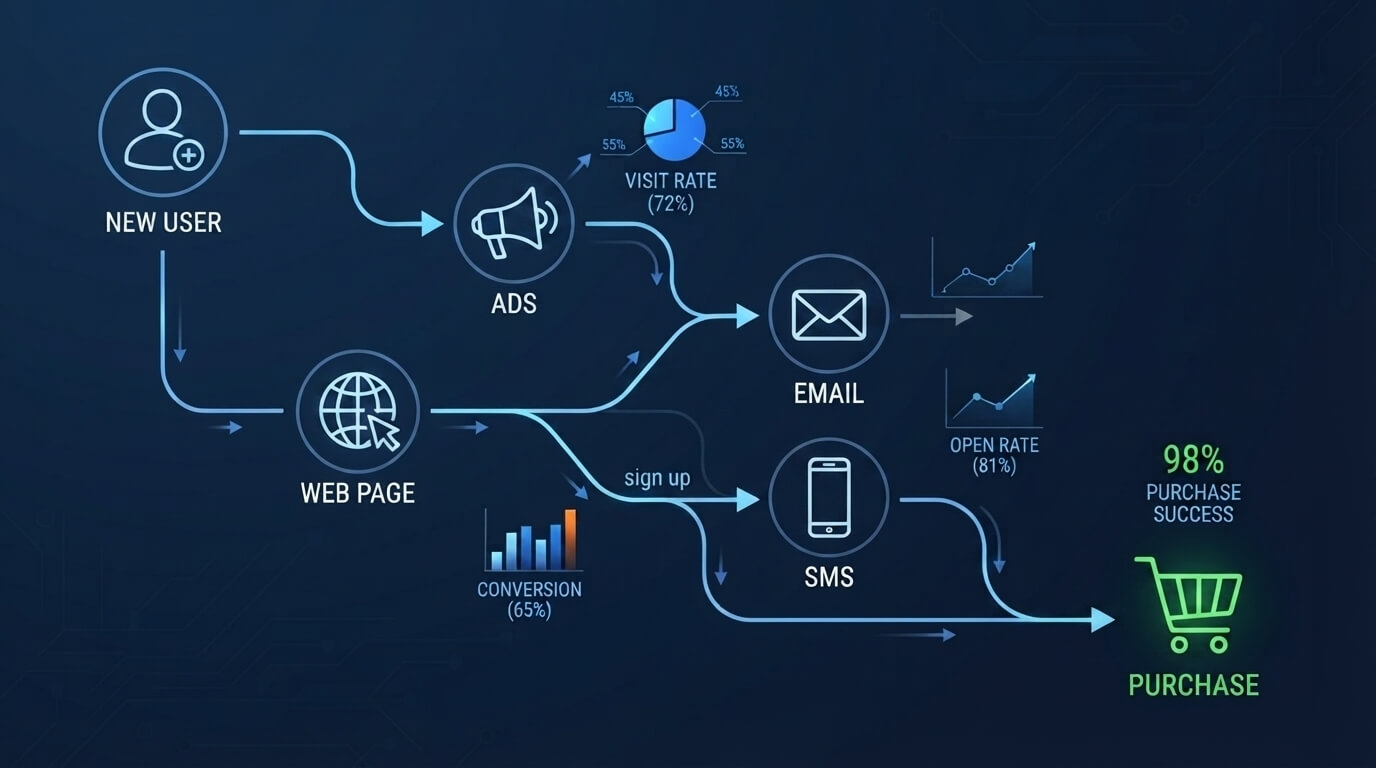
In the past, marketing automation tools were simple. There were specific “triggers” we could define to automate email sending. Although, we are now capable of much more. In a marketing technology discussion in 2026, you’ll hear many elaborate on “agentic AI.”
Vendors are introducing goal-oriented, autonomous agents to tools that once relied on strict if-this-then-that logic. Now, potential buyers are left wondering what is actually useful and what is just a rebranding.
This guide is intended for marketing directors and operators who will be selecting, updating, or implementing automation tools in 2026.
This guide won’t tell you who to buy from. Stacks, budgets, and data maturity will vary from organization to organization.
Instead, we will cover the capabilities, expected advancements from AI agents in the tools, vendor selection pitfalls, and the most common rollout errors.

Why Marketing Automation Still Matters in an AI-First World
AI is a powerful tool, but it doesn’t erase the need for Marketing Automation. If anything, the two working in conjunction add even more value. Marketing automation platforms are still the best ways to track potential customers and connect customer data across different points. and build marketing campaigns. Lead scoring and impact reporting will still be necessary as AI helps build and send marketing campaigns much faster.
Now, marketing teams are working with a fleet of AI tools, and automation is still a foundational need of each marketing department. After an analysis of the marketing automation tools on the market, it was reported that the average marketing team utilizes roughly two times the amount of AI tools and agents when compared to roughly 6 months ago, with expert projections stating that each marketing team will have multiple AI tools and agents in the next year or two.
The Core Categories of Marketing Automation Tools
There are numerous automation tools available that serve a variety of functions. Before jumping to specific tool comparisons, termination business demands and functional requirements to allow separation automation software. Avoid the need to customize monolithic tool suites by accurately demarcating business processes.
- Email and lifecycle marketing: Marketing automation means email and lifecycle marketing, but really it means drip campaigns, nurture sequences, behavior triggers, and win-back flows. This is where most teams begin, and for good reason. Mail Mint helps WooCommerce businesses use these automated email workflows to increase sales and drive repeat purchases. It is the foundation for retention and conversion marketing.
- Lead scoring and qualification: means evaluating tools that empower sales teams to prioritize accounts based on engagement and demographics to eliminate leads chasing.
- Omni channel personalization: means ensuring a consistent customer experience. This means the same message is delivered across email, sms, push, web, and in-app.
- Workflow and operations automation: pulls everything together. Automation tools like Zapier or n8n move and sync data across systems and automate tasks.
The majority of expanding teams will need a mix of two or more of the first four listed categories, and the majority of the time, the ideal platform will be the one that thoroughly addresses one of these categories, rather than the one that claims to address all four.
What’s Actually New: Agentic AI Inside Automation Platforms
This is where the game has really changed. Traditional marketing automation is driven by rules a human being has to write out, like “if a lead opens three emails, add them to this list.” Agentic AI drives the systems to achieve goals, like lowering churn or improving the qualified sales pipeline, by figuring out how and adapting as it goes.
A few specific examples of what this will entail are as follows:
- Churn prediction agents: Churn prediction agents that monitor behavioral signals, sentiment of support tickets, signs of engagement drop and automatically initiate the intervention workflow instead of relying on manual detection.
- Content and campaign agents: Agents that optimize content by drafting and conducting multivariate tests, and based on the dynamic results, automatically change the budget and message across the various channels.
- For teams still producing those drafts by hand, a dedicated AI email writer can output subject lines and body copy in seconds, giving the agent a usable starting point to refine through multivariate testing.
- Multi-agent collaboration: A system of many agents where one conducts the data analysis, a second one customizes the content, and a third one determines the appropriate channel and timing, and all of them work in conjunction towards the same objective.
Given that so many of these agents are calling themselves “AI agents,” it is perfectly fair to be a little skeptical of the marketing around this latest trend. A question to ask those agents would be to tell you about a specific example of where the agent made an autonomous decision, rather than just cite a specific task that the agent performed upon instruction.
A Practical Checklist for Evaluating a Platform
Demos of a system are designed to showcase the strengths of the system and conceal any weaknesses. Use a more rigorous, structured checklist to assess how systems on your shortlist actually function, rather than evaluating the demo quality of the sales pitch.
Data integration
- Does it link with your CRM, advertising platforms, and analytics tools, or will custom middleware be required?
- What will happen to First Party data as Third Party cookies phase out?
- Can your team easily extract data from the tool in case of a migration to a new vendor?
Pricing model
- Do you pay based on contacts, active users, emails sent, or “agent actions”? Each pricing model favors different types of usage, and some can get quite expensive.
- Are AI features included, or are they priced separately?
- What do you think the cost will be at 2X and 5X your current volume – not just today?
Scalability
- Will the value of the platform go down as your team doubles, and your contacts triple?
- Is it going to be able to support the features you need in 18 months?
Support and onboarding
- Is there a dedicated onboarding period, or are you handed documentation and left to figure it out?
- What is the actual support time/response time on tickets?
Website performance should also be evaluated before adopting a marketing automation platform. Tracking scripts, personalization tools, chat widgets, and third-party integrations can increase page load times and negatively affect the user experience. Teams can use a Core Web Vitals Checker to measure loading speed, visual stability, and responsiveness before and after implementation. Regular performance checks help identify scripts that are slowing down important landing pages, reducing conversions, or creating technical SEO issues.
Common Mistakes Businesses Make When Adopting Automation
Most automation rollouts fail because of the implementation, not the tool. There are common patterns that lead to the failures:
- Mapping the process after buying the platform: Teams buy the tool, then try to conform their existing workflows to the tool. The ideal lead to customer journey should be mapped first, then purchase the software that supports that workflow.
- Letting data hygiene slide: Automating using your CRM means more duplicating records, outdated fields, inconsistent tagging, and more. Garbage in, garbage automated.
- Turning on too much at once: Automation intended to simplify and enhance processes will backfire if all processes are automated in one go. Trigger automation and campaign automation will be in direct conflict and the overall flow of automation control will become chaotic.
- Ignoring governance for AI agents: When AI is given the ability to make autonomous decisions, content can be sent or budgets changed without human intervention. In order to maintain guardrails such as brand voice, compliance, and the wrong metric overrides, someone must take ownership and oversight of AI.
- Treating rollout as an IT project instead of a change management project: Most people view the introduction of a new tool into an organization as an IT project and ignore that it is a Change Management project. For a tool to be effective, the people using the tool must understand the why behind the process and not just the how of the tool.
Successful platform adoption also depends on how effectively employees are trained to use it. Growing organizations may need structured learning programs covering workflows, data governance, reporting, and responsible AI use. When evaluating LMS Software Companies, businesses should consider integration capabilities, course management, analytics, scalability, and support for different learning formats. A suitable LMS can standardize onboarding, track employee progress, and ensure teams understand both the technical features and operational processes required to use new automation tools effectively.
A Quick Comparison Framework by Business Size
Small and mid-sized businesses (SMB)
The primary focus should be on time-to-value and the relative costs. A significant tool for automation can be a single strong app with a workflow automation tool. For larger markets or Mid-Market, score based multi-channel tools with customer relationship management integrations will be essential. Additionally, you will want tools to help ease the transition and grow without needing to change the tool itself again.
Mid-market:
As business size begins to scale and expand, the value of complex multi-channel automation and CRM personalization is seen. With Mid-Market teams, the need to choose a scalable platform with good native integrations to avoid custom integration nightmares begins.
Enterprise:
Enterprise buyers think integration depth, governance, and orchestration scope. At scale, the question is not if every platform contains AI agents (they all do), but if AI agents operate with real brand/controls and compliance, if the platform can connect the dots across broad and complex data infrastructure, and if it will create more data silos.
A 30-Day Rollout Plan for Teams Adopting a New Platform
Week 1 – Build the Foundation: Conduct a data audit of all contact data, records, tags, segments, and automations. Remove duplicates and standardize data. Decide to whom the ownership of the transition will belong, and designate that person.
Week 2 – Build the Core: Core Setup Integrate the remaining key data sources and your CRM. Connect your CRM to other data sources by creating one complete workflow (i.e., a lead nurture sequence). Basic reporting should be built to validate the activity.
Week 3 – Build the Expand: Run the core workflow on the limited subset of data. Stabilize the workflow and fix the issues that arise. Start migration of the next workflow. If the platform in question provides built-in AI agents, they can be tested on low-risk tasks that will be monitored.
Week 4 – Scale and review: Run your process on your full data set and add in all of your processes. Hold a team meeting to identify the risks associated with each process. Build a system to limit your risks. Document your system to streamline the onboarding process for your next team member.
The Bottom Line
In 2026, marketing automation is more advanced than standard Digital marketing automation ever was. It is a range, including basic, rule-based automation, as well as fully autonomous, decision-making entities. All of this advanced technology does come with a cost, and some of the fundamentals remain. Like with all things, there are trade-offs and a price to be paid.
When configuring a new system, it pays to have clean data and a realistic vision of what the system will bring. Use the system that has the most useful features for the automation you plan to implement, and fits the processes you really have to do. Avoid the “feature-rich” systems. Getting value is more likely with a useful system that fits your processes.
In the past, marketing automation tools were simple. There were specific “triggers” we could define to automate email sending. Although, we are now capable of much more. In a marketing technology discussion in 2026, you’ll hear many elaborate on “agentic AI.” Vendors are introducing goal-oriented, autonomous agents to tools that once relied on strict if-this-then-that…
Author Bio: Hari is a digital marketer and automation enthusiast passionate about helping teams leverage AI to scale their operations efficiently. You can connect with him on https://www.linkedin.com/in/thenabanda-hari/ to talk all things marketing tech